Pages

.

Analysis: The Great Gatsby and The Pecuniary American Dream

            In F. Scott Fitzgerad’s novel The Great Gatsby, one of the main ideas of the novel is that the American dream of success is being defined by wealth and status instead of by freedom and individualism. The 1920s was a decade of wealth, consumerism, and prosperity, with many new people becoming rich quickly through the stock market and the booming economy. However, with all of this change in lifestyle came a conservative retaliation, from those who have been rich all their lives and believe the people with this “new money” are tarnishing the country. The American dream also morphed for the poor, as they began to believe that the only way to be happy and successful in life is to be wealthy, as money appears to solve all of the rich people’s problems. Each of the characters in The Great Gatsby signifies one of these aspects of American society: Daisy and Tom Buchanan symbolize old-fashioned traditions, Gatsby and Nick represent the newcomers into the world of prosperity, and the Wilson family are the poor, dreaming aspect of American life, wishing for something more in their seemingly insignificant lives. F. Scott Fitzgerald’s novel The Great Gatsby is a social commentary on the American culture of the roaring 1920s, showing how the traditional American dream of freedom and individuality crumbled beneath a mountain of wealth, greed, oppression, and carelessness.
            To contextualize, the 1920s was the period following World War I, and as Eric Foner states, “With its flappers (young, sexually liberated women), speakeasies (nightclubs that sold liquor in violation of Prohibition), and a soaring stock market fueled by easy credit and a get-rich-quick outlook, it was a time of revolt against moral rules inherited from the nineteenth century,” (Foner 819). This was a decade when new industries relating to cars and electronics sprung into existence, such as General Motors. Due to this increase in available consumer goods, American society became more concentrated on the buying and selling of these products. Credit, in which people could buy products now and pay later, became more popular, and advertising also became more prominent in American life. It was also the time that saw America’s first celebrities, like the actor Charlie Chaplin, baseball star Babe Ruth, and aviator Charles Lindbergh. However, there were many Americans who resented these newfound liberties, viewing them to be immoral, and they also feared the new ethnic and racial diversity found in American cities. With a reemergence of the Klu Klux Klan and the Monkey Scopes Trial combating the idea of Social Darwinism, it seemed like there were many traditional Americans not ready for change. Along with these traditionalists, there were also the poor, who mostly lived on farms or in the cities as low-wage workers. These people looked up to the rich and affluent, thinking that wealth was the key to happiness, and moved out East to attempt a climb to prosperity. All of these aspects of American society are represented in The Great Gatsby, with the most prominent example being Gatsby himself.
            James Gatz is a poor man living a rich man’s sham. He grows up out west in North Dakota, and dreams of wealth and success: “The most grotesque and fantastic conceits haunted him in his bed at night. A universe of ineffable gaudiness spun itself out in his brain…each night he added to the pattern of his fancies…they were a satisfactory hint of the unreality of reality,” (Fitzgerald 99). After he meets Daisy, he decides to act on his fantasies. He is in love with her, but due to her status in the upper echelons of society, he believes that the only way they can be together is if he becomes rich. This is displayed during the scene in which Gatsby shows Daisy his house: “He [Gatsby] hadn’t once ceased looking at Daisy, and I think he revalued everything in his house according to the measure of response it drew from her [Daisy’s] well-loved eyes,” (91). His method of making money, though, is shrouded in mystery. For a good portion of the book, Gatsby hides his past from the other characters, arousing suspicion and spreading rumors. Tom is the one who discovers that Gatsby made his fortune by taking advantage of Prohibition and illegally selling alcoholic beverages with Mr. Wolfstein. This begs the question: why should a man have to resort to breaking the law to achieve a noble goal? Why is money so intertwined with this vision of happiness? Ultimately, his fortune does not win Daisy over, and Gatsby dies alone. Money and status did not help Gatsby achieve his dream at all. As shown by the lives of the Buchanans, money and status can lead to personal dissatisfaction and relationships lacking substance.
            Tom and Daisy Buchanan are two people who have been born into a fabricated version of the American Dream. Tom comes from a very wealthy and old family, while Daisy is a southern belle from a comfortable family. The two get married because Daisy appears to be the ideal wife for a man of Tom’s stature. True love does not exist in their relationship, as Tom carelessly has an illicit affair with another woman. When Gatsby returns, he decides to make a fortune to attract Daisy back, as he believes that is the only way to rekindle their old romance. However, Daisy becomes disenchanted with Gatsby, as the new materialistic Gatsby is too similar to Tom, the disloyal and unpleasant man she’s already married to. Daisy and Tom are also not fond of the “new money” in American culture. During one of Gatsby’s parties, Nick observes, “She [Daisy] was appalled by West Egg, this unprecedented ‘place’ that Broadway had begotten upon a Long Island fishing village – appalled by its raw vigor that chafed under old euphemisms and by the too obtrusive fate that herded its inhabitants along a short-cut from nothing to nothing,” (107). This traditional mindset represents the backlash towards all these new aspects of American culture, but ironically, since both Tom and Daisy have technically achieved the American dream of monetary happiness, the American dream is backwards. Daisy is trapped in an unhappy marriage with a man she does not love because leaving him would ruin her pristine image of an innocent southern belle. However, poor woman have more freedoms, such as the right to work in factories and be with whomever they want without facing social repercussions. African Americans look up to men like Tom, but do not realize that those men are selfish men who would prefer that Africans be enslaved again, as Tom says, “It’s up to us, who are the dominant race, to watch out or these other races will have control of things,” (13). Ironically, by pursuing wealth, all these people are achieving is a lifestyle of less freedom and individuality, and more focused on image and material objects. However, people like Myrtle Wilson still strive for this lifestyle, and remain ignorant towards its hidden vices.
            Myrtle and George Wilson live a lower-class lifestyle while striving to succeed. Mr. Wilson is an honest businessman who owns a car repair shop, but his hard work results in low wages. His lack of money is shown by how he borrows a suit to wear to his wedding with Myrtle, which causes Myrtle to believe their marriage is a mistake: “The only crazy I was was when I married him. He borrowed somebody’s best suit to get married in, and never told me about it,” (35). Myrtle believes that the ideal life is one of objects, wealth, and appearances. She wears the fanciest clothing she can find, and cheats on her husband with Tom so she can feel rich by association. When Tom buys her a dog in the novel, she does not know anything about the breed or how to take care of it. However, because Myrtle sees rich people walk around with lapdogs, she wants a lapdog as well, so she can appear rich. As for Tom, he is attracted to Myrtle because, at heart, he is the opposite of high class: he is racist, sexist, selfish, and he disrespects his wife. Myrtle represents a fantastical escape from his dispassionate marriage. As Tom is part of an upper echelon of society, he is not able to freely be with Myrtle without potentially sacrificing his reputation, which is another example of the oppression that comes with being upper class. Finally, when Myrtle is killed, Tom and Daisy take no responsibility for their crimes despite their guilt. Instead, the burden falls upon Mr. Wilson, the honest businessman who does nothing wrong, and because he feels justice will not prevail in this case, he takes matters into his own hands. The end result is Gatsby getting shot by Mr. Wilson, Mr. Wilson then killing himself, and the Buchanans cowardly retreating back into the security of their money. Why do the honest yet poor people have to clean up the mess? Is the American dream truly about abandoning responsibility in such a crude manner? According to the protagonist Nick Carraway, and therefore F. Scott Fitzgerald, the American dream should be about something entirely different.
            Being wealthy in 1920s America comes with its own restrictions and misconceptions, but even today, people still believe money can buy happiness, and strive to be wealthy. As displayed in The Great Gatsby, everyone who is not rich wants to be rich, but the people who are rich do not actually achieve their desires. The character that finds a middle ground in the novel is Nick Carraway. Nick is a middle-class man from out West, who moves East out of necessity. Over the course of the novel, Nick observes and analyzes the behaviors of the other characters, specifically Daisy, Tom, and Gatsby. His reaction is disgust, except towards Gatsby. He instead comes to the conclusion that “it was what preyed on Gatsby, what foul dust floated in the wake of his dreams,” that really destroyed him (2). In other words, outside forces, specifically the misguided desire to be wealthy as a solution to one’s problems, corrupted what was otherwise a noble cause of wooing the woman he loves. Fitzgerald points out multiple times that his characters that have supposedly achieved the American dream of wealth are discontent. Daisy and Tom are not in love with each other, Gatsby is not able to achieve his goal of being with Daisy by dazzling her with his wealth, and the Wilson family is destroyed because of Myrtle’s wish to feel rich. The only character to truly see through all this corruption is Nick, the observer. He ultimately comes to the conclusion that the so-called “American dream” is corrupt. Nick’s character illustrates Fitzgerald’s message that wealth does not guarantee happiness, but the search for individualism and sincere self-expression is in itself a method of attaining freedom and happiness. Nick exemplifies F. Scott Fitzgerald’s ideal American dream by finding solace in writing about his experiences at his home in the Midwest, without ever amassing a huge fortune and remaining true to himself.

Works Cited
Fitzgerald, F. Scott. The Great Gatsby. New York: Scribner, 2004. Print.
Foner, Eric. Give Me Liberty: An American History. 3rd ed. Vol. 1. New York: W.W. Norton,

            2012. Print.
reade more... Résuméabuiyad

Anime Review: Winter 2015 Anime Season

Winter was definitely an interesting season for anime. There were quite a few shows that gained some popularity in the beginning of the season, but then the hype faded as the quality dropped for a few of them. Anime that were going to be favorites of mine decided to make 180s and become either boring, bad, or both, and anime that I wasn't even planning on watching made it on my favorites list. This just goes to show why I shouldn't hype myself up over shows that haven't finished airing yet ._. Then there were the shows where I expected great things, and got great things, though those were sequels, so does that count? Ah, whatever. Here are my final thoughts on the anime I finished this season:
Death Parade:
I’m actually planning on releasing a QuickThoughts video about this anime soon, so I’ll keep this section of the post short. Death Parade was an entertaining show to watch weekly. The episodic stories that developed new and different characters were very interesting to watch and I found myself really liking it. The show was new, it wasn’t afraid to incorporate some psychological elements, the presentation is out of this world, and the characters were pretty likable. That is, until the finale went and ruined it for me. I really did not like how this show decided to end. The final episode felt rushed and relied too much on melodrama instead of actually founding a subtle basis for emotional connection beforehand. Not to mention that the show tried to present its ideas through pretty hurried exposition, which left no time for the actual events to sink in, and when it ended, I was left unsatisfied. However, I don't think it's a bad show, because when it's good, it's insanely good; but the not as good elements are glaring, and comes very close to overshadowing a decent show. Overall, I’d say that the quality of this show is very inconsistent, depending on the episode. There are some episodes that absolutely blew me away with how good they are, especially episodes eight and nine, but then there were others that felt empty and/or pointless. Though, I’d still say it’s an above average watch, and would recommend it to someone who needs something unique. I give it a 6 out of 10.
Yuri Kuma Arashi:
A ton of controversy surrounding this show arose in the beginning of the season only for the community to move on around a week later. Well, I said in my Winter First Impressions that I liked the show, and that hasn’t changed in the slightest. Actually, the show got better as it progressed. The last few episodes were really good, and I liked how the show decided to focus more on the character relationships later on, incorporating all of the strange surrealism and ideas it mentioned with it. As for all the themes in the show, that probably deserves a longer blog post or video if I wanted to talk about them in depth, but the main idea is to not conform, as to conform is to be invisible. Although, I will admit that the show has some problems. The characters could’ve received more time to develop, and there were a few plot holes, but at the same time, Yuri Kuma was more about expressing emotion than anything else, and for that, I praise it. I give it a 7 out of 10.
Your Lie in April:
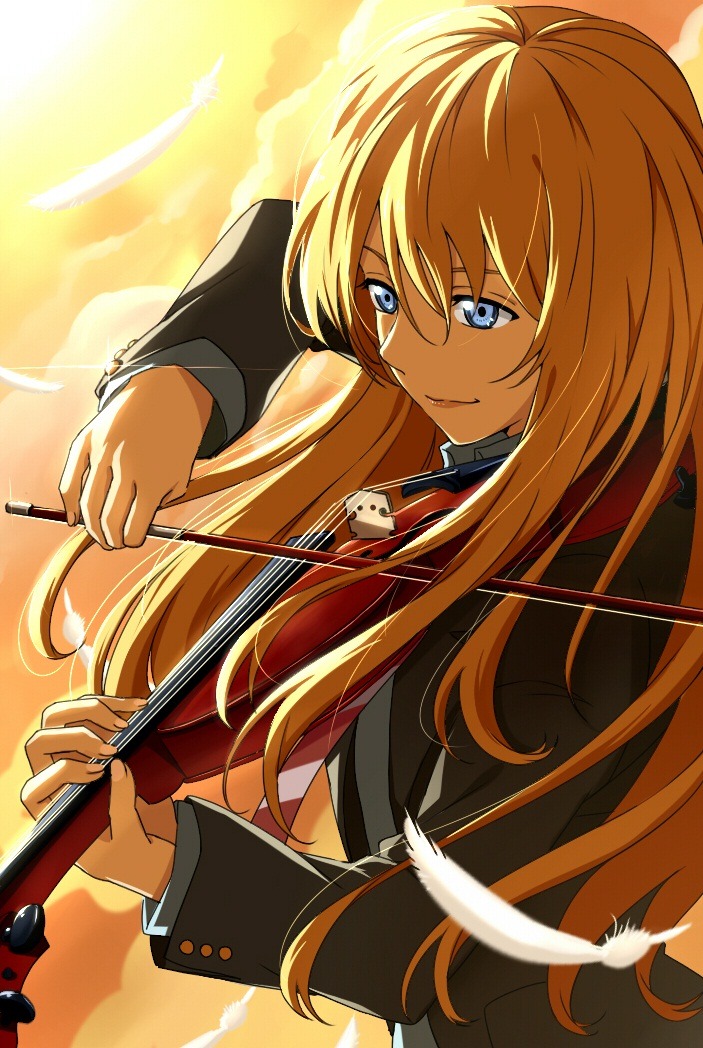
I honestly don’t think anyone expected this anime to be nearly as popular as it turned out to be. I mean, yeah, A-1 Pictures produced it, but for a mature romance anime to become popular is a huge rarity. As for my thoughts on this show, I liked it, but I didn’t fall in love with it like basically everybody else did. For one, the second half was not nearly as good as the first, and while I don’t think it’s bad, it has its issues. Like, why did the show shift the focus away from Kousei’s and Kaori’s relationship, which is the best part of the show, to multiple irrelevant side stories? However, what this show does well, it does incredibly well. Kousei is one of the best main characters I’ve seen in quite some time, with a definable personality and great character development. Kaori’s very well written too, acting as a juxtaposition to Kousei’s quite demeanor by being bright, upbeat, and extroverted. I also love the visuals, not just for its technical grace, but also for its symbolism and beautiful color pallet, creating some very powerful scenes. I’d recommend checking it out if you need a good romance anime, or want a good introduction to anime revolving around music. I give it a 7 out of 10.
Parasyte the maxim:
Ah, Parasyte. What a ride this has been. This show was thrilling, intense, heartfelt, and well written, at least for the most part. Towards the end, there were some writing choices that felt a little rushed and unneeded, and the last two episodes were like "Ferngully With Monsters: The Anime", but overall, I still really enjoyed this show, and think it's one of the best fall leftovers from 2014. It's certainly one of the best thrillers to come out in recent years, and the character development of both Migi and Shinichi is handled really well. The good far outweighs the bad here, and while I do think the manga is better, the anime is still a great watch. My only real complaint besides the strange ending was the dubstep music, which ranged from decent (like "Next To You", my favorite from the OST) to downright mood-breaking. I give it a 7.5 out of 10.
Durarara!!x2 Shou:
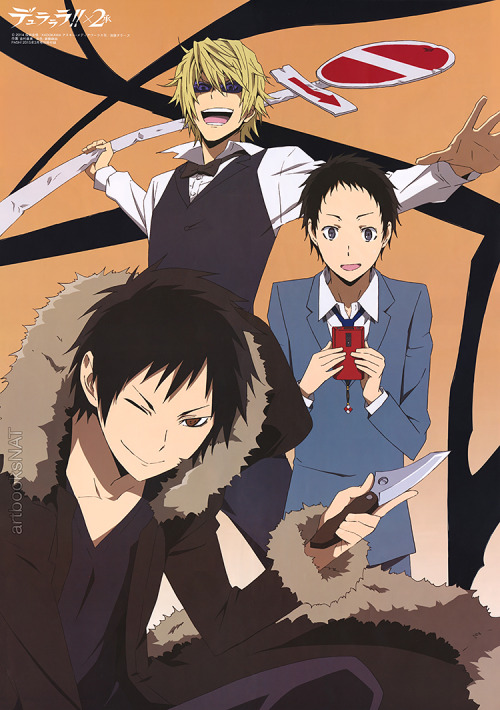
Oh, Durarara!!. Of course you'd be anime of the season. Why did I ever think otherwise? Okay, technically, the next show I'll be talking about is anime of the season, but that show began airing in Fall 2014, so if we're talking about pure 2015 anime, then it'd be Durarara!!x2 Shou. All of the insanity from the first season is still here, with brand new characters and events to spice things up, and the pacing has actually improved from the first season. Okay, yeah, it did feel slightly rushed at times, and there were moments where I had trouble understanding what was going on, but those were the exact same problems I had with the first season, and that's also what makes the show so enjoyable. You watch Durarara!! for the cool characters and seeing them end up in insane situations that you can't ever see coming, and I think that this season actually did a better job with that setup than the first. The only aspect I didn't like was the obvious drop in animation quality from Season 1, but Studio Shuka is just starting out, so I'll cut them some slack. Not every new studio can be a MAPPA or a Wit, I guess. Also, the cliffhanger at the end of episode 12 is the bane of my existence. I give it an 8 out of 10.

Yona of the Dawn:
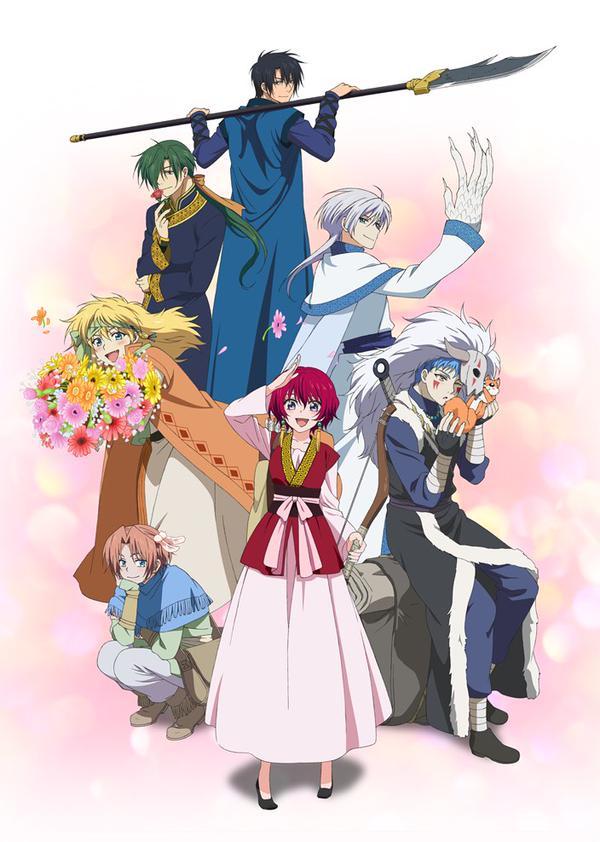
Sometimes, you come across a show that you have absolutely no expectations for, but it turns out to be the best thing you've seen in quite some time. That is Yona of the Dawn for me. I did not expect this to be nearly as good as it turned out to be, and it's now high on my favorites list. The story was well paced, the world building was solid, the character development for nearly every character was absolutely fantastic, the character interactions were fun to watch and helped build character, and the presentation was just great! Studio Pirreot did a fantastic job with the coloring and the lighting, and the actual animation was fluid. The OST is the best from the season, no contest (except maybe Durarara!!x2). This show is now high on my favorites list, and that's a pretty big feat. Second season when? I give it a 9 out of 10.
P.S. Yona x Hak is my OTP.

So, that's what I finished watching over the Winter Season! Here are some anime I may check out later:
Maria The Virgin Witch: I heard good things about it, so even though it's outside of my normal comfort zone, I'll give it a shot.
Garo The Animation: I saw the first episode, thought it was really good, and put it on hold to watch when it's finished airing. I'll get around to it eventually.
Yatterman Night: Heard mixed things, but I'll try it out anyway.
Magic Kaito: I'm actually watching this right now (at least after Jojo's Bizarre Adventure 2012), so expect some thoughts on this in the future.
Shirobako: This was probably the most well-received anime of 2014-2015, so why wouldn't I watch it? 
The Seven Deadly Sins: I heard something about this eventually being on Netflix or something. If that's true, I'll watch it.

And here's what I dropped:
Tokyo Ghoul √A: I got bored really quickly. Still haven't seen past the first episode, and I don't really intend on continuing it.
The Rolling Girls: Same as the former, except I lasted until the fifth episode. The first two episodes were so enjoyable, but then it just got dull and uninteresting.
Saekano: Hated episode 0, but I heard that the actual show is different. May watch it again, but I'm not putting myself through more episode 0s if I can help it.

What are your thoughts on this season? Leave it in the comments and I'll see you all next time!

reade more... Résuméabuiyad

Fangirl February: Fullmetal Alchemist 2003 Review


Video Version:

Ever since I’ve started watching anime, I’ve always had a fear of rewatching my favorite shows, the reason being I’m afraid that I won’t like the show nearly as much as I did during my first viewing. For example, the first time I watched Sankarea, I really loved it. I thought it was a fantastic romance story that had some problems, but I was willing enough to forgive the anime for them. The second time I watched it, however, I was surprised by how much I didn’t like it. The small issues that I forgave earlier were suddenly unbearable, and I was almost unable to stomach the clichés. Not to mention the annoying and downright mood-breaking fanservice in this show, making it worse. Of course, this isn’t always the case. I recently rewatched My Teen Romantic Comedy SNAFU, and that second viewing just reminded me of how much I loved the show. So, when I came up with the idea of Fangirl February, I decided to also test myself to see how much my tastes have actually changed. I was prepared to watch my favorite anime movie and show, and accept that maybe they weren’t worthy of being favorites. However, that didn’t happen. My second viewing of The Disappearance of Haruhi Suzumiya proved that I still loved the movie, and allowed me to realize just why I liked it so much. The same happened during my rewatch of Fullmetal Alchemist 2003. Going in with a more critical mindset, I did find some problems with it, but I also gained much more of an appreciation for how good it was, and I can safely say that it’s still my favorite anime of all time. Sit back, relax, and read on as I complete Fangirl February with my review of Fullmetal Alchemist 2003. Be aware that there may be slight spoilers, but nothing too major will be given away.
Story:
I’m going to try not to waste your time with a plot synopsis that you’ve probably heard a million times beforehand, but on the off chance that you’ve never heard of Fullmetal Alchemist, well, here’s the basic story. Two brothers named Edward and Alphonse Elric live in a fictional country called Amestris, and have unfortunately lost their mother when they were very young. However, the two are rising alchemists, so when they feel they’ve learned enough, they try to bring her back using human transmutation, a forbidden practice since basically no one has survived this transaction. This results in Ed losing his right leg, and Al losing his entire body. A desperate Ed attaches Al’s soul to a nearby suit of armor, and loses his right arm in turn. As a result, Alphonse is basically a walking suit of armor, and half of Ed’s limbs are now made of metal, thanks to a couple automail mechanics they happen to know. However, the boys are determined to fix their mistake and get their bodies back, and so they begin their journey to search for the philosopher’s stone, a device said to defy all the laws of alchemy, especially the one about equivalent exchange. This is where the story begins, and what a great story this is. I’ve mentioned this in an earlier video about Akiyuki Shimbo, but the best way to start a story is by utilizing something simple that the audience can understand. In this case, you want the brothers to find the philosopher’s stone in order to regain their bodies, and the show does a great job in getting you invested. This allows for other story elements to build gradually, without confusing the viewer with too much information at the beginning. Though, I do think that the main topic to discuss here is the fact that FMA 2003 deviates from the manga, and how this has angered a good portion of the anime community. In other words, so many people claim that Brotherhood is better solely because it follows the manga. And, when compared, I do kind of see where people are coming from. Brotherhood’s story is more linear, has slightly better pacing, and gets a lot more done than FMA 2003 in terms of battles and the addition of new characters. But, this isn’t a review of Brotherhood, and I never intended it to be. This is a review of the original, and here’s why I think it’s more appealing to me. I’ve always liked anime and books that are focused more on characterization and character development, because, like I’ve said many times, if you don’t care about the characters, then why should you care about what happens in the story? An anime can have one of the blandest and clichéd stories I’ve ever seen, but so long as I like the characters, then I’ll continue watching. This is what FMA 2003 excels at: characters. The so-called “filler” episodes aren’t just there to fill time, they’re there to assist Edward and Alphonse’s development as characters, and to tie into the central theme of the show: that life isn’t fair. Equivalent exchange is not much of reality when you’re shown all this unfairness to the people in Amestris, and in other places, now is it? So why continue to believe it? Heck, this exact question is asked to Edward in the final few episodes! The answer, however, is one you have to answer yourself. Will you give up on all your hard work because of your cynicism, or remain optimistic and pursue your dreams even further? That depends on you. Not to mention all of the brilliant foreshadowing in this show. I heard that, during the production of FMA 2003, the mangaka herself wanted Studio Bones to create their own ending, and it shows, since even scenes that happened in Brotherhood foreshadow later events For example, say, when Edward and Alphonse are on the island for the second time in episode 28, they find footprints. I’m paraphrasing here, but Al says something like, “Hey, Ed, are those your handprints in the sand?” And Ed responds, “No, mine are automail.” But, then they find a certain anime original character. Those who’ve seen the show know exactly whom I’m talking about, and I’m betting that you didn’t notice that quip of dialogue, at least not on your first viewing. And that’s not the only one, but the others would kind of spoil the story if I specifically point them out, and I don’t want to ruin the fun. If I had to nitpick somewhat, I guess that the pacing can be a bit slow at times, but it never really got to the point where I was sitting there waiting for something to happen. Overall, the story is very well foreshadowed, paced, and thoroughly thought-out down to the very last necessary detail, and is one of the best stories in anime in my opinion.
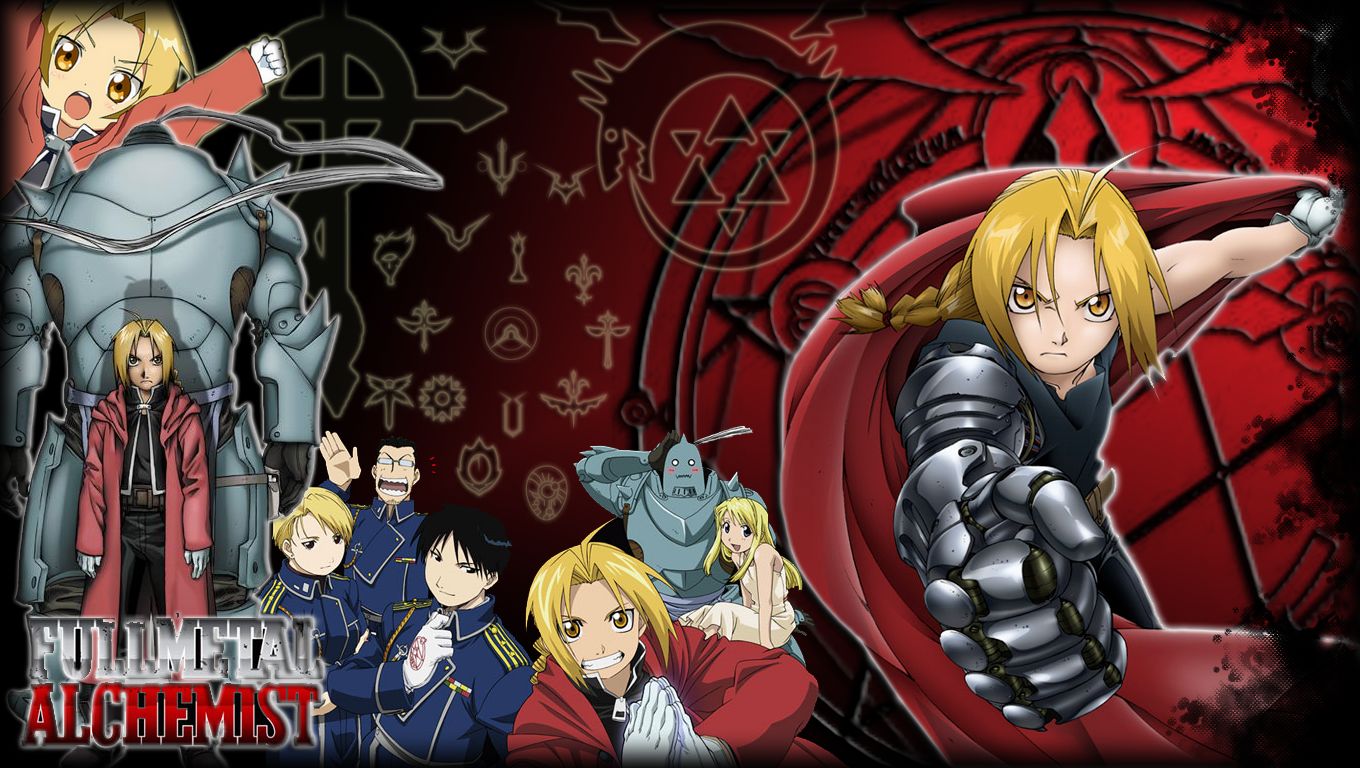
The show follows Edward and Alphonse Elric as they search for the Philosopher's Stone
Characters:
Like I stated earlier, this anime excels in the character department, to the point where this is one of the few anime that I’d give this show a straight 10/10 to this show in the character department. Basically every character in this show serves some purpose in the story, whether it’s to develop the theme or the characters or enhance the world building, and yes, this does apply to the characters that only show up once or twice. Though, I should probably stop ignoring the elephant in the room and discuss the Elric brothers. Firstly, there’s Edward Elric. Ed and Roy Mustang are pretty much the choice favorites of the fans of this franchise, but for me personally, Ed is my favorite character in the entire show and is one of my favorite characters of all time. In fact, if I never watched SNAFU, the character review for my favorite male character would’ve been about Edward Elric. While I don’t want to spend too much time on him, since there are other characters I do want to cover, I will say that he is one of the most realistic shonen characters in anime. Something that the shonen genre suffers from is that the protagonists normally fall under two archetypes: The bland self-insert with no discernable personality or development outside of him just being a nice guy, or the edgemaster who’s super edgy and dark and brooding and thirsty for revenge and is reckless and defies the social norms. But, on the inside, he’s a nice guy who cares about those close to him. Also, did I mention he was edgy? Edward is none of those. Okay, that’s kind of a lie; technically, he’s a variation of the second option, but honestly, that’s a massive stretch. Edward is rather moody, cynical, and has a short temper (HAH), but none of these traits are portrayed as over-the-top or even really emphasized. Well, except when you call him short, but that’s for comedic effect. I think what makes Edward stand out, though, is his relationship with his brother, Alphonse. Ed is the best older sibling in anime, no questions asked, and it is shown that he’d do anything for his brother’s safety. This character trait makes Edward grow up quickly, and because of this is rather mature for a fifteen year old. Though, like the show points out, Ed still has a lot to learn about the world, and that’s the seed of his character development in this version. Though, the amazing part of his development is that, even though parts of Ed have changed, he still feels like Edward Elric at the end of the show, which is a pretty big feat of writing. Next, there’s Al, who is also a really good character. He’s very naïve and innocent, but has a heart of gold and isn’t scared of questioning his brother’s judgment. His naivety is probably a result of Edward’s over-protectiveness, as Ed tries his best to shield Al from the harshness of the world. And, Ed’s not the only older brother to do this; remember the Ishbalan children, Leo and Rick? Leo is a mature older brother who’d do anything to protect Rick since there’s no one else there to look out for him, and as a result, Rick is more caring, trusting, and naïve. And, what about the fake Elric brothers, Russell and Fletcher? Russell is an older brother who’s focused on accomplishing his goal no matter the consequences, while Fletcher is more innocent and ready to sympathize with the real Elric brothers. In other words, each brother balances out the other, with the older brother being more protective and reckless and the younger brother being more sensible and innocent. These pairs of brothers reflect the relationship between Ed and Al, to show how there are people similar to them in the world working to achieve their goals. And this is only a taste of the ingenious characters in this show that I haven’t mentioned yet. Roy Mustang, Maes Hughes, Winry Rockbell, Riza Hawkeye, Alex Louis Armstrong, Furor Bradley, Hoenhiem of Light, Dante, and the homunculi that I can’t even talk about because of spoilers are all great in their own right. The only character I would consider to be somewhat bad would probably be Lt. Archer. He’s pretty underdeveloped in comparison to the rest of the cast. But, he’s my only real problem with the characters. Overall, this is one of the best casts of characters in anime.
The characters of FMA
Presentation:
The esteemed Studio Bones produced Fullmetal Alchemist in 2003, and for its time, the animation is rather impressive. There’s never any huge drop in quality, but when it looks good, it actually looks better than most anime coming out today. However, it is design and coloring that this anime really nails. The colors like to lean towards desert colors, like sand-yellow and light brown, with some blues here and there. This gives the anime a gritty atmosphere, which, might I add, is also great. The backgrounds and general settings all look nice, which is a plus. I also really like the character designs. They’re all memorable, even the side characters. It’s very distinctly Fullmetal Alchemist, though I do see the resemblance in the artist’s other works like Silver Spoon and The Heroic Legend of Arslan…at least, in the images I’ve seen. I need to watch Silver Spoon, and The Heroic Legend of Arslan doesn’t really exist yet…anyway, back to FMA. The soundtrack is awesome. Each piece helps set the atmosphere perfectly, with either ominous, ethereal, or playful tones. My personal favorites are Philosopher’s Stone, Brothers, and Dante’s Theme. Then, there’s the English dub. I’m sure that the Japanese version is more accurate and better acting and whatever, but I love the English dub of FMA. I think the main reason is Vic Migona’s performance as Edward Elric, which is probably one of the best English performances in any animated project period, including major American animated films. Even if you don’t like English dubs, I’d say give it a shot, but if you don’t like it, just go with the sub I suppose.
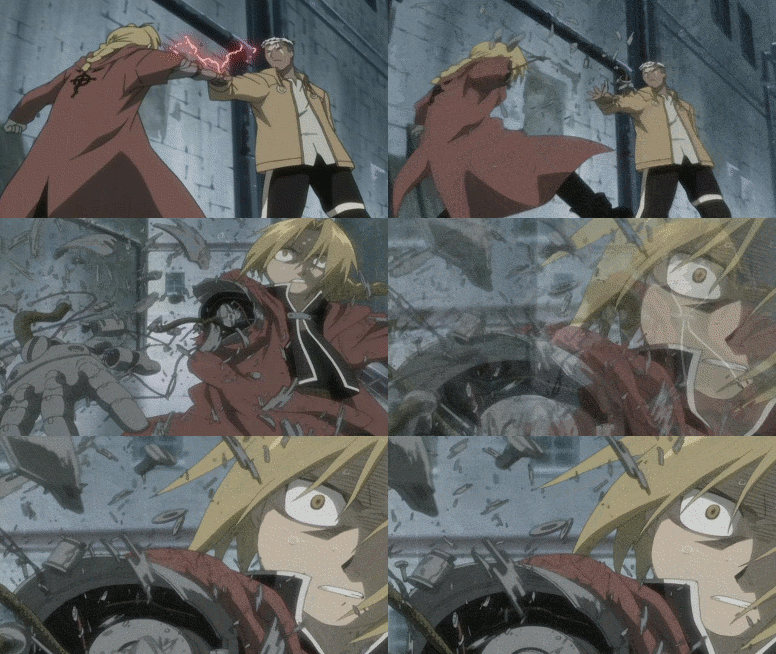
For its time especially, the animation is great (looks slightly grainy because of the gif though)
Why It’s Featured in Fangirl February:
Fullmetal Alchemist 2003 is my favorite anime of all time for many, many reasons. Superficially, it’s because nearly every aspect is pretty much perfect. It has a story that keeps you hooked and emotionally involved. It has main characters that you get attached to easily, and side characters that are just as likable. Its presentation is fantastic, especially for the time period, with consistent animation and a phenomenal soundtrack. But, a whole ton of anime are like that, so what makes FMA so special? Well, it’s because of how human the show is. There is a lot of moral ambiguity, and nothing within the show is black and white. Every character has a motive, and even if their actions are downright despicable, you can understand why. This is all because of the anime’s focus on the characters and not on having a huge epic story like Brotherhood did. 2003 feels more down to earth and simple, with enough leeway to flesh out the characters without feeling too slow. This is the show that made me realize how important characters are in any story, because without good characters, you don’t care about what’s going to happen to them in the story, therefore depriving the story of any tension or suspense whatsoever. 2003 made that clear through its storytelling and emphasis on character, because without me being able to understand these characters, most of the conflicts in the story would feel hollow and manipulative instead of exciting and suspenseful. Just like how Needless showed me how characters can absolutely ruin a show by being stupid, unreletable, and obnoxious, FMA showed me how characters are the link between the piece of entertainment and the audience, and that the quality of their development and characterization is truly what makes an anime fantastic. And for that, I’m eternally grateful.
Conclusion:

Overall, Fullmetal Alchemist 2003 is my favorite anime of all time for what I believe to be good reasons. The story is great from basically any angle, the characters are some of the best in anime, and the presentation is really good, especially for its time. I give Fullmetal Alchemist 2003 a straight 10/10. No scorecard, just a 10/10. I know that objectively, it should get slightly less, but from a subjective standpoint, it’s the best of the best for me, and it deserves the best rating possible. And, with that, Fangirl February comes to a close. I hope you enjoyed this second installment in my February Specials series! I sure had fun doing it, despite it being delayed on multiple occasions. I’ll see you all in my next review, which will be on...something. Until then!
reade more... Résuméabuiyad