Pages

.

Showing posts with label TV Show Reviews. Show all posts

Rick and Morty: “The Ricklantis Mixup” (S3 E7) Recap and Review


After waiting two weeks after the premiere of the previous episode, “Rest and Ricklaxation,” the stellar Rick and Morty is back, and proves yet again why it’s one of the best shows currently airing on TV. With a focus on world-building, this new episode seamlessly combines four different storylines into one, laces each one with sharp political commentary addressing the numerous ills plaguing the Rick Citadel, and seems to finally continue the main cliffhanger from season 1 concerning Eyepatch Morty, though that is still left fairly ambiguous. Oh, and of course, it’s all punctuated with hilarity and fantastic voice acting on Justin Roiland’s part. What makes this episode unique, though, is that it accomplishes all this in the most Rick and Morty way; by using and expanding upon the infinite versions of Rick and the infinite versions of Morty to shape the world they reside in, and reflect our own society.
The episode begins with the main Rick and the main Morty, the ones who act as the protagonists for most of the show. They are preparing to go to Atlantis when another, nondescript Rick and Morty show up through a portal. Nondescript Rick asks Main Rick if he’d like to contribute to the Rick Citadel Redevelopment Fund. Remember that Main Rick is the one who destroyed the citadel’s Council of Ricks in the first place. Main Rick refuses, with Main Morty making some snide comments to accompany those of his grandfather. Nondescript Rick is slightly taken aback by how assertive Main Morty is, and then leaves the scene with Nondescript Morty. Main Morty is surprised to learn that Ricks and Mortys were still living in the Citadel, whereas Main Rick replies with, “Anyone continuing to explore the Citadel is either stupid, or one of the unfortunate millions held hostage by their terrible ideas.” With that, Main Rick and Main Morty then go to Atlantis, but instead of following them on their fun adventure, the focus of the episode shifts to the Citadel of Ricks.
Immediately upon entering the Citadel, the audience is given a clear picture of the power divide between Ricks and Mortys, as you see the frustrated Campaign Manager Morty (who’s wearing a shirt and tie, and who you find out is a campaign manager later in the episode) trying to get a taxi, but the taxi speeding by to pick up a random Rick in a suit and tie, much to Campaign Manager Morty’s distaste. You also see Cop Rick complete his training, and then a bunch of Mortys closing their lockers, all of which have a picture of Morty’s crush Jessica within them, as they amble off to class under the watchful eye of Teacher Rick. Then you see Factory Rick riding on a train to work glancing despondently at a Rick, who hasthe same IQ and credentials as him, enjoy the high life. After an advertisement for Simple Rick’s Wafers, the news then announces that the campaign for the new, democratically-elected leader of the citadel is beginning, and that, strangely enough, a Morty was running for the position, much to the amusement of the newscasters, since a Morty can’t possibly beat a Rick in their eyes.
From the footage shown, Candidate Morty seems to be standing up for the civil rights of Mortys, who are constantly trampled upon or straight-up abandoned by their Ricks all the time, and you can tell that tension between the Ricks and Mortys is tightening, marking a potential period of drastic change. Of course, though, the Ricks don’t catch on. Finally, Campaign Manager Morty is shown on screen again, discouraging Candidate Morty from participating in the debate, though Candidate Morty is strangely confident about it, which is more than a little strange for the stereotypically cowardly and weak-minded Morty.
Following that, you see a Morty parade, and an onlooking Cop Rick, sipping coffee and waiting for his partner to pick him up. His partner arrives, nearly running over some celebrating Mortys in the process. To Cop Rick’s surprise, his partner is a Morty, and a particularly ruthless one at that. When a Marching Morty announces that “Mortys Are Human,” Cop Morty electrifies him after screaming at him, much to Cop Rick’s dismay. They’re called in to address a robbery in Morty Town and head off.
Next we switch back to the Morty School, where Teacher Rick is teaching them how to be ideal Mortys. One Morty stands out - the Slick Morty, who talks with his friends Lizard Morty, Fat Morty, and Glasses Morty after class. They decide to go to the wishing portal on their last day together, despite the risk of ending up in Morty Town if they don’t show up for graduation. After that we cut to Factory Rick at his boring factory job, but in a turn of events, his boss announces that his position will be opening up. Factory Rick is hopeful, but then his boss announces that he hired another, completely unrelated Rick as the new boss, shattering Factory Rick’s hopes. Factory Rick raises his hand to ask why, and is completely ignored.
Next, the Cop Rick storyline is continued, and we finally get to see what Morty Town actually looks like. It bears an uncanny resemblance to real-life lower class city neighborhoods; hardened Mortys running amok, homeless Mortys sitting by the fire they made in a steel canister, and vaguely threatening music playing in the background. Cop Rick is utterly dismayed and despondent, while Cop Morty is callous and indifferent. They arrive at the store that was robbed, where Owner Morty tries to give them information. Unsatisfied, Cop Morty approaches some random Mortys on the street and violently coerces them into revealing the identities of the criminals. Cop Rick points out that Cop Morty violated many codes, but Code Morty doesn’t care, and the cops leave.
Following that, we are shown the Presidential Debate, where we see Candidate Morty face off against the entourage of Candidate Ricks. The latter all have fairly stupid and incomprehensible answers, but they still get applause based on the fact that, well, they’re Ricks that still sing praises for the Citadel despite its awful state. Despite this, Candidate Morty gets the hardest question to answer - how will he fix the intense divide between Ricks and Mortys - and is made fun of before he even answers the question. Candidate Morty, on the other hand, wins everyone over, by answering with, “The division I see is between the Ricks and Mortys that like the citadel divided, and the rest of us.” As he furthers his point, we are visually shown the different storylines introduced beforehand via montage, convincing his audience - both within and outside the show - that his words are right. Most significantly, Factory Rick gets fed up and shoots his boss, then runs to the Flavor Core and hides. Candidate Morty wins everyone over, and Campaign Manager Morty is fired.
Whoo, that’s a lot of information. And we’re only halfway through the episode. Hang tight there, reader!
After the commercial break, we see Factory Rick resisting arrest, demanding a portal gun to take him off this “prison.” We then cut to a reporter, very terribly reporting on the situation, completely ignoring Factory Rick’s arguments and just telling the viewers to stay in their place, because “it could always be worse.” The news then switches to the election, and it is announced that Candidate Morty has become the favored candidate to win. When asked about his original reality and original Rick, Candidate Morty states that he can’t remember, though his words feel fake, indicating that maybe he does remember and just doesn’t want to share? This is the instance when I first felt suspicious of him, and his possible connection to the episode Close Rickcounters of the Rick Kind. The scene transitions to focus on Campaign Manager Morty watching Candidate Morty on the screen, and my suspicions were furthered when Detective Rick gives Campaign Manager Morty some incriminating files related to Candidate Morty.
Then, we see another group of Mortys watching Candidate Morty on another television, where they talk to Rickman, who appears to be constructing something for the gang. Cop Rick and Cop Morty bust down the door, and Rickman tries to escape with his bootleg portal gun, only to fail. Cop Rick searches the place, where he comes across a crying Morty. Cop Rick picks him up and carries him out, only for Crying Morty to literally stab him in the back. Cop Rick throws Crying Morty off of him and shoots. Cop Morty walks in and explains that Mortys sometimes do that to emotionally manipulate Ricks, while bandaging his wounds. Cop Morty tells Cop Rick to go back to the car, and with Cop Rick’s back turned, Cop Morty disintegrates the building they were just in, killing the gang of Mortys inside.   
Next we see the group of Mortys searching for the wishing pool. They try to pick some exotic fruit but are verbally attacked by Redneck Rick, who owns the farm. At night, we see the friends talk about what they think they’ll find at the wishing portal. Slick Morty is the most pessimistic, and reveals that his Rick gave him a drama implant, who makes everybody sad and down. His friends comfort him. Afterwards, we see Campaign Manager Morty attempt to assassinate Candidate Morty, because of the information on the incriminating files Campaign Morty received earlier.
Following that, Cop Morty and Cop Rick go to the Creepy Morty, a bar and quasi-dance club. They meet up with Big Morty, who likes to “contribute to keeping the peace in Morty Town,” but it’s very clear that Big Morty just wants the town clear of his enemies, as he’s a drug lord. Cop Rick states that, even though Morty Town is bad, as cops, they shouldn’t be stooping down to their level. Cop Rick tries to arrest Big Morty, with Cop Morty helping Cop Rick and a gunfight going down. Cop Morty gets Big Morty on the ground, and Cop Rick tries to convince him to do the right thing, which Cop Morty does not, resulting in the death of both Big Morty and Cop Morty, the latter by Cop Rick’s hands. Cop Rick exists the bar and turns himself in, saying, “The same old story. Ricks killing Mortys.”
Next we cut back to Factory Rick, who receives his portal gun. To test it, Factory Rick unplugs Simple Rick and tosses him into the portal, but as it turns out, it was a portal to the Blender Dimension. Factory Rick screams at the cops that he’s the Rickest Rick, and to come get him, until the owner of the factory comes out and pardons him...only to force Factory Rick to take Simple Rick’s place as the source of Simple Rick’s Wafers. Afterwards, the group of Mortys come across the Wishing Portal, where each friend gives up something important for the hopes of gaining something better. Slick Morty then wishes that life on the citadel would change, and sacrifices himself to the wish portal - or, as we learn, the garbage dump.
After that, we see Campaign Manager Morty explain his actions, only to realize his efforts were fruitless, as Candidate Morty lives, and is now President Morty. Campaign Manager Morty is cast out into the endless abyss of space. We then see Cop Rick, wondering why he hasn’t been cast out into space, when he’s freed from imprisonment. Confused, Cop Rick asks why, and they say it’s because there are new departmental codes, so therefore he hasn’t violated anything. Then, we cut to the group of friends, who come to a changed school with no graduation. They celebrate how Slick Morty’s wish must have come true.
Finally, and most importantly, we focus on President Morty’s meeting with a council of businessmen Ricks. The Ricks all talk about how they don’t care who’s in the seat, since they’d been running the citadel long before the council came along. Then, President Morty orders the execution of all the dissenting Ricks, leaving the indifferent Ricks completely bewildered and terrified. He ends the episode with the line, “Speeches are for campaigning. Now, is the time for action.” We see a shot of all the Ricks and Mortys that died over the course of the episode, and then the credits roll, with foreboding music playing in the background (“For The Damaged Coda” by Blonde Redhead if anyone’s interested).
If you stay until after the credits, though, the depression and tension are diffused with an entertaining scene featuring Main Rick and Main Morty happily recounting their time in Atlantis. Morty does wonder what’s going on in the citadel, but Rick says that it will have no bearing on their lives whatsoever, and the episode ends.
There is so much information to unpack in this episode that it honestly astounds me, and all of it is presented in twenty-two measly minutes. Allusions to the real world are clearly made, including but not limited to Morty Town’s resemblance to The Hood, the struggles of the working class, the way school tries to beat the uniqueness out of its students, dirty cops literally getting away with murder, how businesses secretly control everything, and, most importantly, how politicians can target and exploit societal divisions for their own personal gain.
The episode is very clearly a commentary on how racism and classism can distort everyone involved, whether it be the Mortys forced to live in a slum or the Ricks being disappointed in themselves for not living up to the potential that has supposedly been imposed on them. Both sides are displayed to have both strengths and weaknesses; the Ricks are smart, but callous and oppressive. The Mortys are the underdogs and are clearly victims of a cruel system, but they can still manipulate and control the system in negative ways. If this divide didn’t exist, then both sides might be at peace, but the issue lies in the Ricks continually attempting to suppress the Morty population. Everything can be traced back to, shall we call it, the “Ricktriarchy.”
The most important character of the episode appears to be President Morty, since the incriminating documents Campaign Manager Morty had reveal that President Morty is actually Eyepatch Morty, last seen from the episode “Close Rickcounters of the Rick Kind.” Why is this important? Well, within that episode, Eyepatch Morty is revealed to be the mastermind behind the framing of Main Rick. It would then make sense that President Morty would want to control the citadel; he obviously has a huge bone to pick with Main Rick, and if he gains power over an army of Ricks and Mortys, then he can easily exact his revenge.
In spite of the connection to Main Rick, the true evil of this episode is the way that President Morty gains power; he exploits the clear divide between Ricks and Mortys by promising all of them happiness, while never actually explaining how he will accomplish this or showing his real personality to everyone. His supporters are caught in a daze of despair, and President Morty suddenly gave them hope, and he won the support of the masses who don’t think critically or have any skepticism of what might actually happen in the future. This shows just how diabolical people can be, and he uses the same tactic as the Morty who stabs Cop Rick; pretending to have innocent goals while secretly plotting everyone’s demise.
While the actual content is definitely the most intriguing aspect, I think it is also worth praising Justin Roiland’s incredibly versatile voice acting in this episode. It’s amazing to think that he is the sole person behind the microphone, since he provides the voices for all the Ricks and all the Mortys here. He gives each individual Rick and Morty slightly different tones and word choices, like how Cop Rick is more soft-spoken than most Ricks, how Slick Morty sounds a little more depressed than your average Morty, and how President Morty speaks with loads of confidence and is very articulate, without any sort of the classic Morty stammer. How someone has the talent to convey different interpretations of the same character so subtly and effectively is beyond me.
Overall, “The Ricklantis Mixup” is now my new favorite episode of the entire series, not just Season 3. It is the most ambitious, it is the most sharply written, it contains phenomenal voice acting, it provides biting political commentary, all its new one-off characters feel defined and real despite getting very little screen time, the Citadel of Ricks feels like a tangible place with conflicts and hardships, and is still hilarious when it needs to be. I don’t think I’ve ever seen an episode combine so different storylines in twenty-two minutes and manage to make every single one work. All I can say is, the excruciating gap between Season 2 and Season 3 was definitely worth it, if not solely because we got this masterpiece of an episode.
reade more... Résuméabuiyad

Bojack Horseman: The Depressing Purpose of its Anthropomorphic Animals


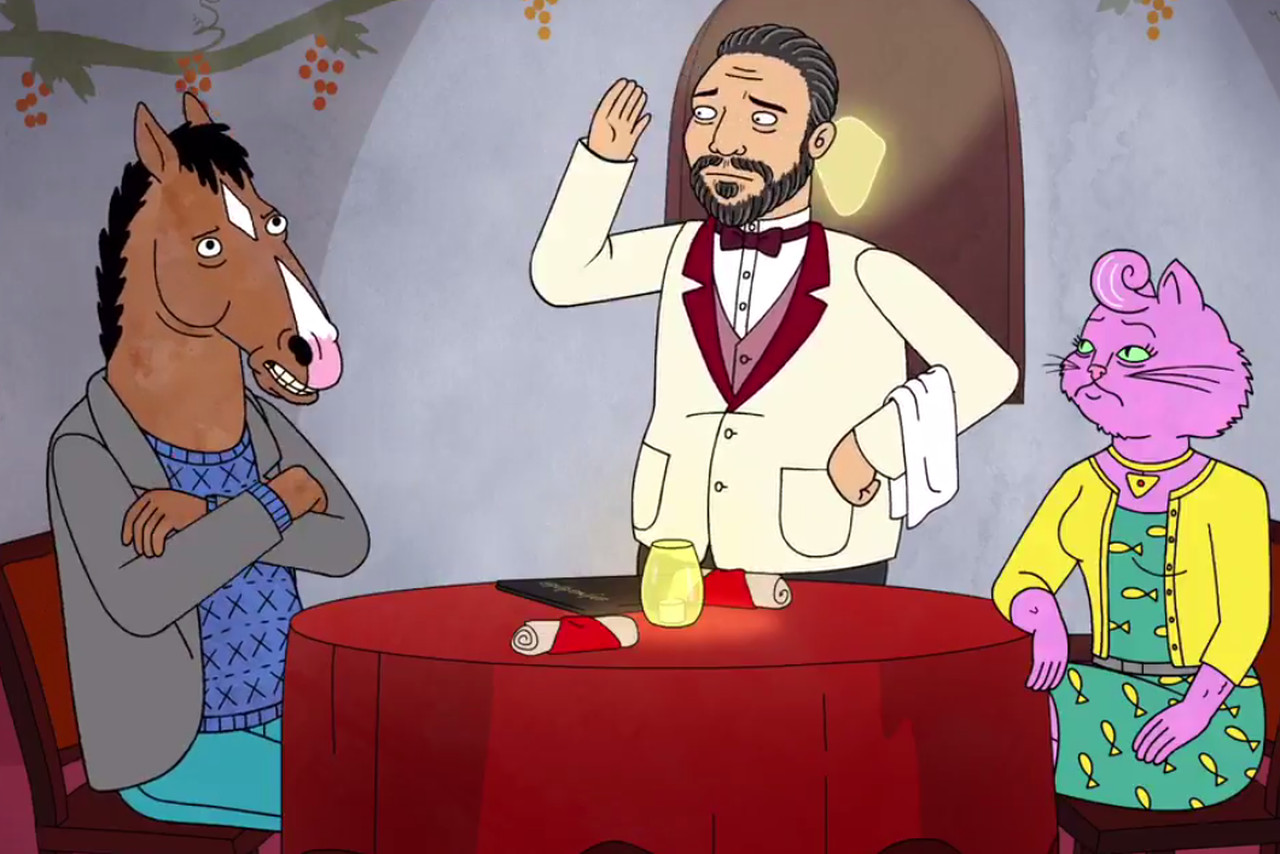
Anthropomorphic animals are a staple of cartoons as much as explosions are a staple of the action genre. Whether it just be talking animals or animals that act and walk like humans, these imaginative characters have found their way into our culture and grew along with the technologies of animation. So, it should be no surprise that anthropomorphic animals also made their way into adult cartoons, specifically in the Netflix show Bojack Horseman. What’s interesting about the main anthropomorphic animal characters of Bojack isn’t the fact that they’re animals walking around and living amongst humans. Instead, the intrigue comes from what the animals those characters are based on represent, and how those animals tie into the show’s main ideas.
            The three main anthropomorphic animal characters are: Bojack Horseman himself, a has-been family sitcom star and sardonic alcoholic; Mr. Peanut Butter, a former star of his own sitcom who’s incredibly cheerful and optimistic; and Princess Carolyn, Bojack’s snarky, brutally honest, and sly agent. Each take on the form of a different animal, with Bojack being a horse, Mr. Peanut Butter being a yellow labrador retriever, and Princess Carolyn being a pink persian cat. One aspect that these animals all have in common in the real world is their reliance on the human race.
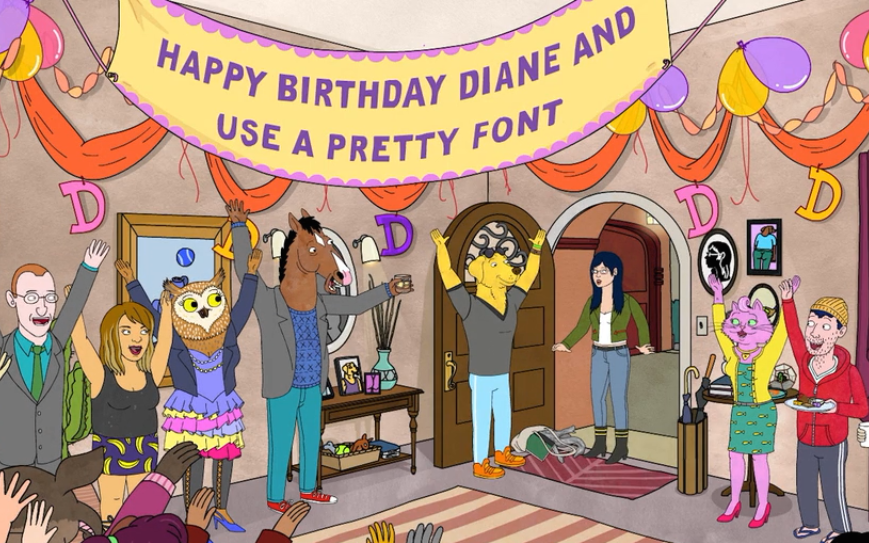
            The dog and cat are obvious examples of this, and it’s also reflected in their personalities. Mr. Peanut Butter is always happy, seemingly oblivious to the fact that he’s a mere tool used to make viewers happy. He revels in his public attention, in his kindness to Diane, and will do anything to please those he loves. Heck, he even admits this when he gives Diane a pendant: “I am D-pendant on you.” This sounds very much like the behavior of a dog, but it’s implemented so subtly that it feels like a human trait. He’s a character so obsessed with giving to those he loves, whether they be his fans or his fiancé, that he ignores what people may actually want. This is like how a dog may roll over when all you want her to do is sit; she overachieves despite you not instructing them to. While a lot of Mr. Peanut Butter’s ignorance and lack of focus on reality is mostly made up for laughs, it all serves the purpose of reinforcing this idea, this complete idealization of some audience that laps up his every action.
            For Princess Carolyn, her connection to this subservience is much more subtle, but then again, so is that of a normal cat. When I think of a cat, I think of a sly, indifferent creature that hangs around, watching every movement and springing at opportunities of self-gain. They also live in a human’s house, which is where they create their own territories and map out their surroundings. This sounds a lot like Princess Carolyn’s character. As a talent agent, she is reliant on her clients for money - her mostly human clients - and springs at any opportunity to gain money. She throws herself into her work because it’s the only thing in her life that keeps her going, but in the end, her work doesn’t benefit her, it only really benefits those she finds jobs for. In the end, all Princess Carolyn amounts to is a depressed cat trying to find happiness, as is explored in season 1 episode 7.
            Now that we’ve covered the cat and the dog, what about the horse? The horse isn’t a commonly subservient animal to humans anymore, right? Well...this is where it gets slightly more complicated. Firstly, it is important to note that, historically, the horse has been humanity’s means of transportation across land long before trains, planes, and automobiles (see what I did there?). The horse was a symbol of power, giving warriors higher ground during battle and made the humans riding them look imposing and dignified. If you need proof, just look at the famous painting of Napoleon, or do some additional research about transportation; the horse was everywhere.
Nowadays, the most horses are used for is to give horseback riding lessons, give rides through the city for no real reason at all, race in the horse races, or help with farming. The animal doesn’t have an incredibly useful place in typical human society anymore, especially if you live in a metropolis or in the suburbs. It feels like the horse has faded into the background, a mere shadow of what it once represented for humanity, especially Western Society. Transportation has evolved, so the horse has become a has-been, a relic of an older era, much like Bojack Horseman himself.
Bojack was the star of an incredibly popular 90’s sitcom Horsin’ Around, but has since gone completely downhill in terms of everything. His life is aimless, deprived of a purpose because his audience has moved on to bigger and better things, like how humanity’s reliance on the horse has almost completely faded over time. Unlike Mr. Peanut Butter and Princess Carolyn, however, Bojack seems to be completely aware of his subservience to humans coming to a complete halt, and struggles to find something else to do with his life. In a way, the horse’s lack of relevance and Bojack’s lack of relevance tie together perfectly, since both are incredibly depressing to watch.
Ultimately, Bojack Horseman uses anthropomorphic animals that are subservient to humans as a metaphor for how celebrities or the people tied to celebrities are subservient to their fans, audiences, clients, or otherwise. Without us, the people consuming their content, these actors would be out of a job and lack a purpose in life. This perfectly leads into an exploration of the tragic has-been, the celebrity whose fame has disappeared and whose name has faded into obscurity. The lack of attention leaves the has-been depressed, alone, aimless, and constantly attempting to get back into the spotlight. Much like how the horse in captivity used to be a vital aspect of humanity’s society, Bojack Horseman used to be a relevant and beloved star. Now, both seemed to have lost their place in the world.
Well, those were some words about Bojack Horseman. I’ll probably write more about this show when I’m actually finished with it, but for now, if you haven’t checked it out, I highly recommend it. This has been HSMediaNerd, here with something not anime-related for once, and I’ll see you guys later!
reade more... Résuméabuiyad

TV Show Review: Breaking Bad

Before I begin, I want to thank all of my followers for sticking with me for more than a year. I’m glad that you enjoy my content, and I hope that I never bore you in the future. In celebration of a year’s worth of book, anime, and movie reviews, here’s something that most probably didn’t expect: a review of an American live-action TV show. Let’s start!
I’m normally not one for watching American television. Sure, I watch the occasional sitcom or cartoon, but for the most part this medium isn’t the most interesting to me. The episodes are normally too long for my taste, and I normally don’t have the time or the patience to sit through five or more seasons of 13-26 44-minute long episodes. This is mainly why I prefer anime: the episodes and seasons are short, and my attention span is worse than that of a goldfish’s. However, just like with movies, anime, and books, there exists this tiny little sect of TV shows referred to as “cultural phenomena”, or, in other words, something that shouldn’t be missed under any circumstances. For example, in anime there’s Cowboy Bebop and Evangelion; in books there’s The Great Gatsby and The Odyssey; and in movies there’s Citizen Kane, Psycho, and The Godfather. The only American TV show to really hit the mark in this category would be the topic of this review: Breaking Bad. It swept the country off its feet and many claim it to be the greatest TV Show of all time. So, I decided to watch it due to its incredible status in the television community. Is this praise deserved, or does Breaking Bad fall flat? Sit back, relax, and read on as I review the cultural phenomenon, Breaking Bad. 
The Setup:
The TV show is set in Albuquerque, New Mexico, and follows a brilliant high school chemistry teacher named Walter White (played by Bryan Cranston). He’s kind of awkward and not the best at communicating with his students, but he manages to live a decent life. He has a wife named Skylar (Anna Gunn), a sixteen-year-old son named Walter Jr. (R.J. Mitte) who unfortunately has cerebral palsy (a physical disability that prevents movements of certain parts of or the entire body), and an unexpected baby on the way. Skylar also has a kleptomaniac sister named Marie (Betsy Brandt), who’s married to a very friendly DEA agent named Hank Schrader (Dean Norris). On his fiftieth birthday (or at least, around that time), Walter is diagnosed with Stage IIIA lung cancer, which by this point is basically a death sentence. Panicked by the prospect of leaving his family alone, he teams up with former student Jesse Pinkman (Aaron Paul) to cook meth and “provide for the family”. This is where the story truly begins, and boy does it begin!
Walter White (right) gets diagnosed with terminal cancer, and teams up with former student Jesse Pinkman to cook meth
The Characters:
The strongest aspects of this show are the characters, by far. Let’s begin with Walter White. Bryan Cranston brings forth one of the best acting performances that I’ve ever seen when portraying this character. Walter does kind of fall into the cliché as the “good character that turns into an anti-hero” archetype, but at the same time you kind of get the sense that he wasn’t truly a great person to begin with. There are no spoilers here, but everything about Walter’s character makes sense with his development progressing at a perfect pace. I would say that Walter definitely falls into the category of a “tragic hero”, despite the fact that he didn’t die due to a fatal flaw. Sure, he has quite a few potentially fatal flaws, like hamartia (intense pride), doing anything and everything for the family, selfishness, and being overprotective, but he never dies because of them. If anything, these traits sometimes save him from danger. Then there’s his brilliance as a chemist, and am I glad to see this done correctly. Chemistry is all about problem solving (this is coming from someone who’s taking AP Chemistry right now), so therefore, chemists are very good problem solvers. I loved how accurate Walter’s skill of getting himself out of unfavorable situations is due to this, because it makes soooo much sense, unlike with most genius characters that are just smart because the show says they are. Overall, Walter White is very complex, very interesting, and shockingly relatable considering his actions later on in the series. Next, there’s Jesse Pinkman, played by Aaron Paul. Boy, does he go through some difficult moments in this show. Jesse is the most sympathetic character in this show, and probably the most likable. Sure, he was a drug addict and not incredibly intelligent (“Yeah, science!”), but you can always tell that he has a heart of gold. I know that sounds incredibly cheesy, but it’s kind of true. In other words, he’s one of the only characters to ever have a true grasp on his humanity, which is ironic considering how he’s technically a criminal and the youngest character besides Walter Junior. This is shown through his sensitivity towards children and those he cares about. It is also worth noting that his relationship with Walter is kind of a hierarchy. I don’t want to spoil how, but when you watch the show you’ll see why. Next, there’s Skylar White, played by Anna Gunn. She’s a character who gradually went from tolerable to pretty annoying. She’s a perfectionist, very uptight, and astoundingly vain, always being concerned with the finer points of every action to make sure that her image remains favorable. I will give her credit, as Anna Gunn’s performance is exceptional and she was pretty sympathetic when Walter was pretty much abandoning her and the family due to his business, but later on it just got really irritating. She’s not a bad character by any stretch; she’s just an unlikable one. If you want to know the worst character of Breaking Bad, that would be Lydia in Season 5, but that’s spoiler territory and this section would turn into a rant if I began discussing her. Anyway, next there’s Hank Schrader, played by Dean Norris. He’s friendly, but whenever he’s not motivated by something his demeanor takes a huge turn for the worse. Let’s just say that he goes through a lot. Then there’s his wife Marie, played by Betsy Brandt, who was my least favorite character for a while but eventually grew on me. This is because, despite being unpleasant, she is shown to do anything for her family no matter the cost, even if it means separating her sister from Walter. That is something that I can respect. Okay, the character section is really long, so I think I’m going to wrap up this section by discussing a character named Gus Fring, played by Giancarlo Esposito. He is probably the most famous villain in the entire show, up there with Tuco and those lethal Cartel twins. I honestly have no idea what to think of him. He’s so terrifying, yet so calm. He’s so interesting, yet so morally repulsive. He’s awesome, but also appears to be so ordinary. All I can say without spoiling his character is that Mr. Espositio’s performance is one of the best acting performances that I’ve ever seen period, even more so than Bryan Cranston…which is saying something.
From left to right, top to bottom: Walter White, Jesse Pinkman, Skylar White, Gus Fring. Saul Goodman, Hank Schrader, Marie Schrader, Mike Armentrout (some were not mentioned due to spoilers)
The Story:
This is unfortunately where some problems appear, and not all are tiny little nitpicks that can just be shaken off. The main issue that I had with this show was it’s pacing. This is entirely due to my own tastes, but the forty-five to sixty minute run-times of the episodes were sometimes pretty taxing to sit through, especially when there wasn’t much going on. And unfortunately there is a lot of dead space in this show as well. I can understand why this can be interpreted as a good thing, as in reality there’s always a separation between the intense and the not-so intense, and it always leans towards the not-so intense, but the not-so intense moments weren’t incredibly entertaining to watch. A lot of it was discussing business or covering up the characters’ tracks, which did get repetitive, but I was able to sit through it because when this show hits the mark…oh, wow, is it phenomenal. The intensity used in the powerful scenes is unlike anything I’ve seen before, and always had me glued to the screen. This show kept on throwing me off, and its atmosphere is incredible. These scenes work so well because of how good the characters are, and how much you want to see them achieve their goals regardless of the moral consequences. However, my favorite episode has nothing to do with drug lords, guns, explosions, or anything of the like: my favorite episode was Season 2 Episode 9, “Four Days Out”. It focused on Walter and Jesse as they were trapped in the desert, and I loved every minute of it due to the interaction between the two of them. The story is so on-point when it’s good that most of the bad can be forgiven, and that final episode was perfect.
The story has some pacing issues, but overall is fantastic
The Themes:
I normally don’t include a section that strictly discusses themes (though I may begin to include this regularly; I’ll let you know if that happens, and if it does, this won’t be included in the ScoreCard), but in Breaking Bad’s case, there are so many interesting messages to talk about and is too important to just be a simple annotation in the story section. Breaking Bad talks about and explores themes of family, loyalty, morality, lying, justice, and vanity, all of which are very important to anyone’s life. The most important theme out of those listed, however, is family, and how far are you willing to go for their sake. Are you able to break the law? Is every terrible action you commit worthwhile as long as it’s for a good cause? Should you arrest your family because of their crimes, while at the same time risking your own position as a police officer? Should you even let your family know about your actions, for fear that you’ll lose their respect? How far are you willing to go for your family? Are you willing to break the law, kill, lie, cheat, or perform other illegalities? Should you be willing to take that risk? Breaking Bad does answer these questions, but at the same time leaves them open-ended enough for the audience to answer them by themselves, as themes should. The show also brings up how lies can fester when not revealed early on, and could lead to huge consequences later on. Actually, that’s another huge theme: consequence. No matter what you do, no matter how you try to prevent them, consequences will arise, and you must be prepared for them. These themes, topped off with fantastic acting, are what makes the show a near masterpiece, at least in my opinion. Never before have I seen something that so seamlessly incorporates this many themes, makes them easy to interpret to the common watcher, and leaves them ambiguous enough due to powerful and convincing performances from the actors present. Bravo, Breaking Bad; bravo. 
The show's themes focus on the family, and how far Walter is willing to go for them
The Presentation:
The presentation of Breaking Bad is also really good, but what else can you expect by this point? Firstly, I really liked how the color scheme changed as the show got darker. In the beginning, the colors always leaned more towards white, though nothing was ever bright per say. In later seasons, everything looked a lot harsher, leaning towards black. The only color to ever stand out would be the blue meth, but I’m not going to spend any more time interpreting why. The usage of visual metaphors is also rather apparent, but not too in-your-face to be annoying. For example, in the beginning of the show, whenever Walter made his transition to become Heisenburg, he’d always walk through a door. However, when Walter and Heisenburg began to become the same person, the door metaphor was used less and less. I’m not entirely sure if this is accurate, but this is just my opinion, so…yeah. The music, when it’s used, is also really good. It’s only really evident during intense scenes or montages, which in my opinion made them more memorable, but there’s nothing that I would listen to outside of the show except for the theme. Oh, how I love the Breaking Bad theme that’s played at the beginning of each episode. It will never get old.
The show becomes sharper and grungier as the seasons pass
Final Judgment:
Despite popular belief, Breaking Bad isn’t perfect; but it’s pretty darn close. The story is a bit problematic, but the phenomenal characters, themes, and presentation more than make up for its issues. I give Breaking Bad a 4.75 out of 5, and a recommendation to watch it regardless of its impact on the television community. It’s dubbed the best television show for a reason. But, like always, it’s up to you to decide your own opinions.
reade more... Résuméabuiyad